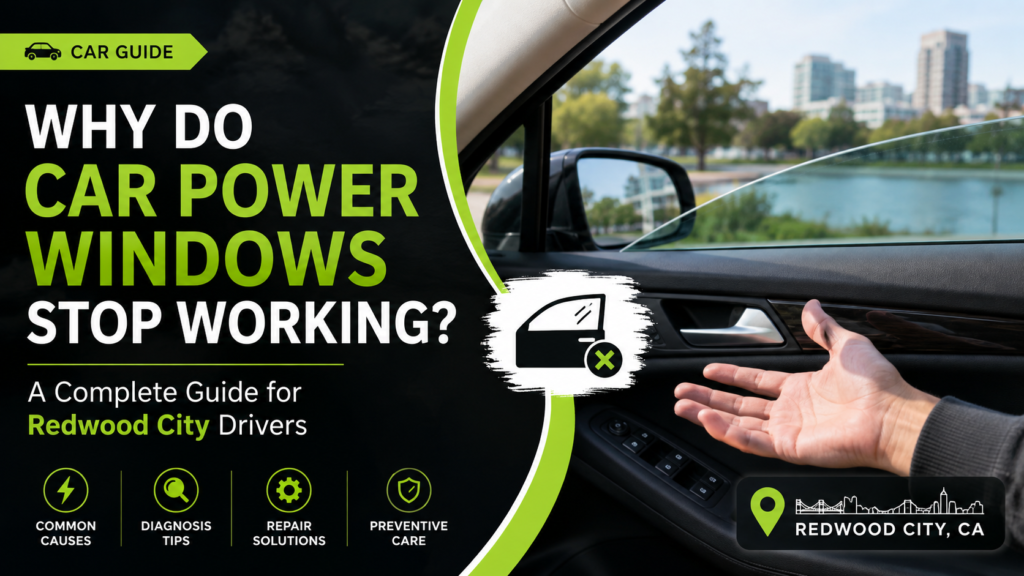
Power windows are one of those vehicle features that earn very little appreciation when they work and enormous frustration the moment they don’t. For drivers in Redwood City and across the San Francisco Peninsula, a power window that suddenly refuses to budge or one that moves sluggishly, makes grinding noises, or gets stuck halfway is an immediate problem that affects comfort, security, and in wet Peninsula weather, the ability to keep rain out of the vehicle interior. Understanding why Power Windows Issue Redwood City fail, how the system actually works, and what each type of failure symptom tells you about the underlying cause empowers Redwood City drivers to make informed decisions about whether a repair is urgent, what to expect from the diagnostic process, and how to avoid the most common causes of premature power window failure.
How Power Windows Actually Work: The Four-Component System
Before understanding why power windows fail, it helps to understand what they are and how the system operates. A power window is a four-part electrical and mechanical system: the window switch, the relay and wiring, the window motor, and the window regulator. Every time you press the switch on your door panel, all four components must work together in sequence for the window to move.
The window switch is the control interface the button or rocker switch on the door panel (and the master control panel on the driver’s door) that you press to operate the window. When you press the switch, it sends an electrical signal through the circuit.
The relay and wiring translate the switch signal into power delivered to the motor. The relay is an electrically operated switch that manages the higher current needed to run the window motor. Fuses protect the circuit from short circuits and overloads a blown fuse cuts power to the circuit entirely. The wiring runs from the switch through the door frame hinge area to the motor inside the door. This hinge area where the door meets the body is where wiring must flex repeatedly with every door opening and closing, making it one of the most mechanically stressed parts of the electrical system.
The window motor is the electric motor inside the door that provides the rotational force to drive the regulator. Motors can be integrated with the regulator as a single assembly (which is the case in most modern vehicles) or separate from it in older designs. The motor converts electrical energy into rotational mechanical energy.
The window regulator converts the motor’s rotation into the up-and-down translational motion of the glass. Regulators come in two primary designs: cable-type regulators (in which a flexible cable attached to the glass slides over a drum driven by the motor) and scissor-type or X-arm regulators (in which a mechanical linkage system converts rotation into vertical motion). Both designs can fail in characteristic ways that produce recognizable symptoms.
Cause #1: Blown Fuse The Easiest Fix First
When a power window suddenly stops working with no warning no slow degradation, no unusual noise, just working one moment and dead the next the most logical first check is the fuse. Every power window circuit is protected by a fuse that breaks the circuit if current exceeds the safe limit. A fuse that blows cuts power to the affected window or windows entirely, producing a complete, sudden failure with no motor sound when the switch is pressed.
Most vehicles have a fuse dedicated to the power window circuit, located in the fuse box (typically in the driver’s footwell or under the hood). The fuse box cover typically has a diagram identifying which fuse corresponds to which circuit. Replacing a blown fuse is the simplest possible power window repair and costs only the price of the fuse itself typically under five dollars.
An important diagnostic clue: if all the windows in the vehicle stopped working simultaneously, a fuse is more likely than if only one window has failed. A blown fuse typically affects all windows on the same circuit. If only one window has failed, the issue is more likely in that window’s specific components the switch, motor, or regulator for that door.
A fuse that blows again immediately after replacement signals an underlying electrical fault a short circuit or a motor that is drawing excessive current that must be diagnosed and corrected. Repeatedly replacing a fuse without addressing the root cause will not solve the problem and could damage other components.
Cause #2: Window Lock Button Accidentally Engaged
This is the power window failure cause that generates the most embarrassing moments in auto glass and repair shops: the window works perfectly, and the problem was that the child lock or window lock button on the driver’s door panel was accidentally engaged. Most vehicles have a window lockout switch a button that cuts power to all window controls except the driver’s as a safety feature for passengers (particularly children) who should not be able to operate their own windows independently.
If all windows except the driver’s window stopped working, and you can hear the motor attempting to operate when you press the switch from the driver’s master panel but not from the individual door switches, the window lock is the first thing to check. The lockout button is typically located on the driver’s door panel below the window switch cluster and may be labeled “window lock” or marked with a lock symbol. Toggle it and try the windows again before pursuing any further diagnosis.
Cause #3: Failed Window Switch
Window switches experience a remarkable amount of mechanical use over the life of a vehicle every time a window is operated, the switch performs one press-and-release cycle that contributes to its cumulative wear. Add to this the exposure that door switches experience to moisture (when you get in or out of the car in rain), sunscreen, beverages, and general contamination, and it becomes clear why switch failure is one of the more common power window problems.
A failed switch can present in two ways: a switch that has failed open (completely dead, producing no response when pressed) or a switch that has failed in a partial or intermittent way (producing inconsistent window operation, sometimes working and sometimes not). Intermittent failure is often the most diagnostically frustrating the window works at the shop but fails again on the commute home.
For Redwood City drivers, the Bay Area’s climate is relevant here. The San Francisco Peninsula’s marine layer means that vehicles parked outdoors accumulate morning dew and occasional fog moisture even in summer. This moisture, over years, can promote corrosion at switch contacts and contribute to the intermittent failures that characterize switch degradation. Switches on the driver’s door which operate all four windows and are pressed far more frequently than individual door switches wear faster than passenger door switches.
Diagnosing a switch failure involves a simple operational test: if a window responds to the driver’s master switch but not to its own door switch, the door switch has likely failed. If a window doesn’t respond to either the master switch or its own door switch, the fault is in the motor, regulator, or wiring rather than the switch.
Cause #4: Window Motor Failure
The window motor is an electric motor inside the door panel that drives the regulator mechanism. Motors can fail through several mechanisms: worn carbon brushes (the contact elements inside the motor that conduct current to the armature), seized bearings, failed windings from overheating, or simple end-of-life wear from years of cycling.
Motor failure typically produces one of two symptom patterns. Sudden motor failure from a winding failure, seized bearing, or overheating event produces a completely dead window with no sound when the switch is pressed (assuming the fuse and switch have been ruled out). Gradual motor failure worn brushes or degraded internal components often produces increasingly sluggish window operation over time: the window that used to move briskly begins to slow, requires multiple presses to complete its travel, or starts moving slower in one direction than the other.
Motor overheating is a specific failure mode that drivers can inadvertently trigger. Holding the switch down past the fully open or closed position of a window keeping the motor running against its mechanical stop generates heat in the motor windings. On older vehicles without automatic stop features, repeatedly forcing the motor against its limits can overheat and damage the windings. Modern vehicles typically have automatic reversal and auto-stop features that prevent this, but older vehicles in the Redwood City area should be operated with this in mind.
Another relevant factor for Redwood City drivers specifically: vehicles that spend long periods parked outdoors on the Peninsula can experience wide temperature swings between cool nights and warmer afternoons, and battery health in an aging vehicle can affect motor performance. A weak or partially discharged battery puts additional strain on all electrical components including window motors, and a motor that performs marginally may fail more consistently when battery voltage is lower. If you notice your windows are slower in the morning than later in the day, battery condition is worth checking alongside the motor.
Cause #5: Window Regulator Failure
The window regulator is the mechanical component inside the door that converts the motor’s rotation into the up-and-down movement of the glass. Regulator failure is one of the most common power window problems and produces some of the most distinctive symptoms.
Cable-type regulators used in most modern vehicles can fail through cable fraying or breakage. The cable that connects the glass to the drive system is under tension each time the window moves, and repeated cycling over thousands of operations can fray the cable until it eventually breaks. When a cable breaks, the window typically drops suddenly into the door with a loud thud sometimes startling drivers who were not expecting it. The window may then be stuck in the down position with no ability to raise it from the switch.
Scissor-type or X-arm regulators can fail through wear of the pivot points that allow the linkage to fold and extend, through deformation of the arms from impact (if the door has been struck), or through failure of the plastic nylon bushings that allow smooth movement at the pivot points. A regulator with worn pivots produces the grinding or clicking sounds that are among the most commonly reported symptoms of power window problems.
A specific regulator failure mode worth understanding: if a window moves but does so unevenly one side of the glass rising faster than the other, causing the glass to sit crooked in the frame the regulator is failing to maintain equal tension at both lifting points. This uneven movement can eventually cause the glass to bind, crack, or fall out of its guide channels.
Plastic gearing within regulators is another failure point. Some regulator designs use plastic components in their drive mechanism that are less durable than metal alternatives. When plastic gearing strips or breaks, the motor runs but the regulator does not move you may hear the motor operating but see no window movement, which can feel similar to a motor failure diagnosis but is actually a regulator mechanical problem.
Cause #6: Wiring and Connector Issues
The door hinge area where the wiring harness must repeatedly flex as the door opens and closes is the most mechanically stressed part of the power window electrical system. Over years of door use, the wires in this area experience thousands of flex cycles that can cause internal wire breakage (where the outer insulation remains intact but the internal conductor has fractured) or connector corrosion.
Redwood City’s coastal climate creates conditions that accelerate connector corrosion. The marine layer deposits moisture on every exposed surface, including the connectors in door wiring harnesses. Over years, this moisture promotes oxidation of the connector pins, increasing resistance in the circuit and eventually preventing adequate current from reaching the motor. Connector corrosion typically presents as intermittent failures the window works sometimes but not others, depending on whether the corroded connector is making adequate contact at a given moment.
Internal wire breakage in the hinge area produces failures that can be difficult to diagnose with a standard multimeter if the break only opens the circuit under the mechanical stress of door movement rather than in the static position where diagnostic testing typically occurs. A technician who suspects hinge-area wire failure may test the circuit while flexing the wiring harness to reproduce the failure condition.
Cause #7: Track and Weatherstripping Resistance
The window glass moves within tracks (guides) inside the door that keep it aligned vertically as it rises and falls. The weatherstripping the rubber seals around the window frame that the glass slides against when moving provides the weather seal when the window is closed. When either the tracks or the weatherstripping create excessive friction, the motor must work harder to move the glass.
A motor that is working against excessive track or weatherstripping resistance will draw more current, generate more heat, and wear out faster than one operating in a well-lubricated, low-friction system. The window may move slowly but still work until the motor eventually fails from the sustained overloading. Lubricating window tracks and weatherstripping with appropriate products (white lithium grease or silicone spray, applied to the rubber seals and track channels) can reduce this resistance and extend motor life.
Weatherstripping that has hardened, swollen, or become distorted conditions that develop over years of temperature cycling and UV exposure in the Bay Area’s climate creates more resistance than new, compliant rubber. This is particularly common in older vehicles whose door seals have never been replaced. If your windows have become noticeably slower over the years without any sudden failure event, check the condition of the weatherstripping and consider lubrication as a maintenance measure.
What to Do When Your Redwood City Power Window Fails
The practical sequence for addressing a power window failure in Redwood City begins with the simplest possible checks and works toward more complex diagnosis.
Check the window lock button first. If all windows except the driver’s window have stopped working, the lockout switch is the most likely explanation. Toggle the window lock button on the driver’s door and test the windows again before doing anything else.
Check the fuse if a window stopped working suddenly with no warning and no sound. The fuse box location is shown in the vehicle’s owner’s manual. Replace the blown fuse with one of the correct amperage rating. If the replacement fuse blows again immediately, there is an underlying electrical fault that requires professional diagnosis.
Listen for the motor when testing a failed window. Press the switch and listen carefully for any sound from the door a faint hum, a clicking, or any sound of the motor attempting to operate. If you hear motor sound but no window movement, the fault is in the regulator or mechanical connection. If you hear nothing at all, the fault is in the electrical path switch, fuse, relay, or wiring.
Secure a window that is stuck in the open position. A window stuck in the down position in Redwood City’s weather is an immediate problem. Use heavy-duty plastic sheeting and tape to cover the opening from the inside while you arrange professional repair, and schedule the repair as soon as possible. Mobile auto glass and window repair services in the Redwood City and Peninsula area can come to your location and perform the diagnosis and repair on-site, eliminating the need to drive with an open window to a shop.
Common Questions About Power Window Issues in Redwood City
Can I replace just the fuse for a power window repair? Yes, if a blown fuse is the actual cause of the failure and if the fuse does not immediately blow again. Replacing a fuse that repeatedly blows without diagnosing the underlying cause of overcurrent will not solve the problem.
My window worked this morning but not this afternoon. Is that normal? Intermittent failures are common in power window systems and usually indicate a marginal component a switch with failing contacts, a motor with worn brushes, or a corroded connector that makes contact sometimes but not others. Intermittent failures tend to become more frequent over time until the component fails completely. Diagnosis while the failure can be reproduced is more effective than waiting until the failure is consistent.
Does the Bay Area’s coastal climate affect power window reliability? Yes. The marine layer, morning fog, and higher ambient humidity of the Redwood City and Peninsula area create conditions that promote connector corrosion, weatherstripping hardening, and the motor overheating that can result from high-friction window operation. Regular lubrication of window tracks and rubber seals, and attention to early signs of window slowdown, helps mitigate these effects.
Is it worth repairing a power window on a high-mileage vehicle? The answer depends on which component has failed. Fuse replacement and switch replacement are inexpensive and make sense on virtually any vehicle. Motor and regulator replacement on a high-mileage vehicle should be evaluated against the vehicle’s overall condition and remaining useful life but on a vehicle that is otherwise running well, a motor or regulator repair is typically worthwhile given that these components can last another 100,000 miles in favorable conditions.